No products in the cart.
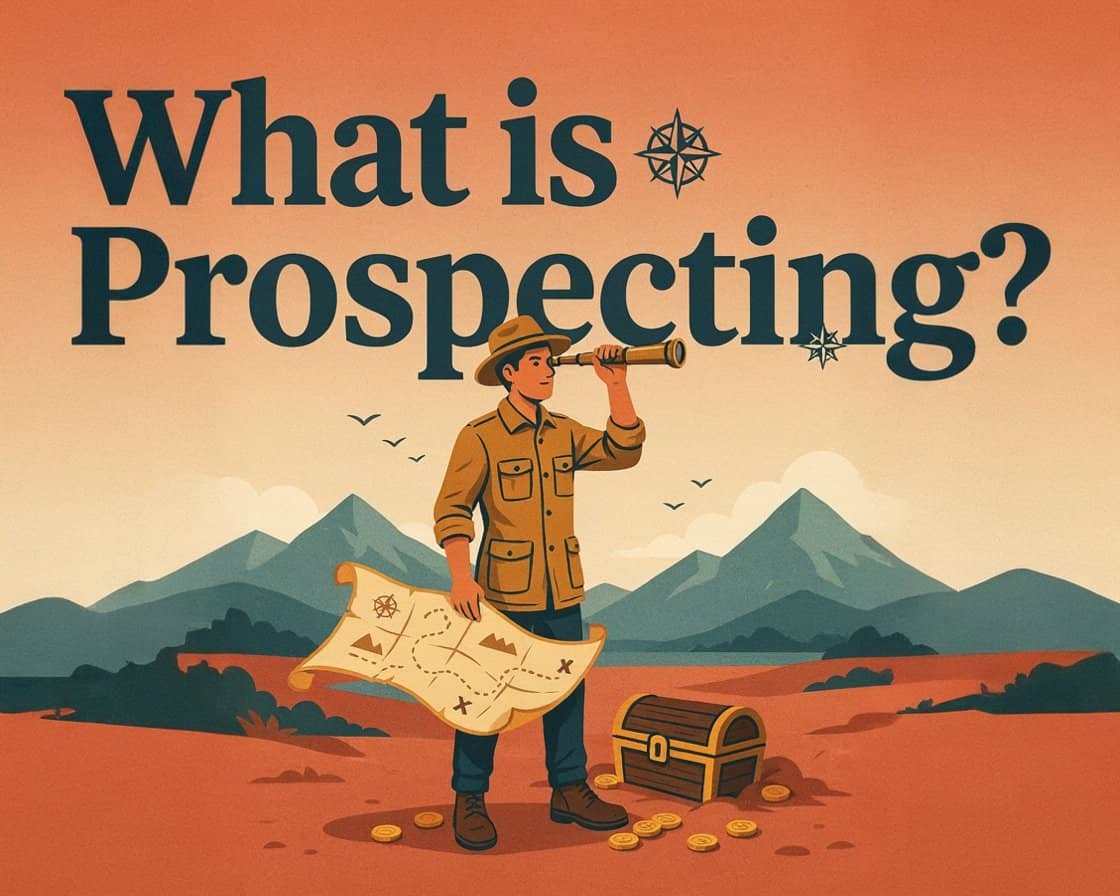
What is Prospecting in B2B? Prospecting Strategies for 2026?
Prospecting is the top-of-funnel discipline of identifying accounts and contacts that match your ideal customer profile (ICP), qualifying them against defined fit and intent criteria, and initiating direct engagement before any lead-nurture sequence, marketing-qualified-lead (MQL) handoff, or opportunity stage ever comes into play. It’s the mechanism that fills a pipeline rather than waits for one to fill itself.
Roughly 40% of sales reps cite prospecting as the hardest part of their job, yet organizations with a disciplined prospecting motion consistently outpace revenue targets by a wide margin. The gap between those two facts is almost entirely a matter of process, data quality, and channel execution — not effort.
The Mechanics of Prospecting
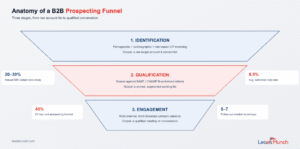
Strip the term down to its components and prospecting resolves into three discrete stages:
Identification
Matching target accounts and contacts against ICP criteria — firmographic filters (industry, employee count, revenue band), technographic signals (installed tech stack), and role-based targeting (title, seniority, department).
Qualification
Scoring identified contacts against a fit-and-intent framework, commonly BANT (Budget, Authority, Need, Timeline) or CHAMP (Challenges, Authority, Money, Prioritization), before any outreach is sent.
Engagement
Initiating direct, personalized contact through a defined channel sequence, with the explicit goal of securing a qualifying conversation or meeting.
What separates prospecting from simple list-building is that qualification step. A leads list of 10,000 emails is not a prospecting motion; a scored, segmented subset with a defined outreach cadence is.
B2B-Specific Mechanics
B2B prospecting operates under structural constraints that don’t apply to consumer contexts:
Extended sales cycles
Complex, high-ACV deals routinely take 4–6 months from first touch to close, which changes how persistence and follow-up cadence should be structured.
Buying committees
Enterprise purchases rarely clear through a single stakeholder. Multi-threading, engaging several roles inside one account in parallel, is often what prevents a deal from stalling when a single champion goes quiet.
Value-framed messaging
Outreach has to be anchored to a specific operational problem, not a generic feature pitch; generic messaging gets filtered out almost immediately by experienced buyers.
Prospecting vs. Lead Generation vs. Nurturing
These terms get used interchangeably, but they sit at distinct points in the funnel and run on opposite logic.
| Motion | Direction | Primary Mechanism |
|---|---|---|
| Prospecting | Outbound/proactive | Rep-driven outreach to ICP-matched accounts |
| Lead generation | Inbound/reactive | Content, SEO, and paid campaigns pulling interest in |
| Lead nurturing | Post-capture | Automated sequences building trust before sales-readiness |
Prospecting and lead generation frequently draw from the same underlying data, but the workflows — and the KPIs that measure them — are not interchangeable. Reply rate and meetings booked govern prospecting; conversion rate and cost-per-lead govern lead gen.
Core Prospecting Channels
Cold calling
Still measurably effective when paired with account research and a script built around a specific trigger event, rather than a generic pitch script run at volume.
Email outreach
The highest-leverage channel on a cost-per-touch basis. Average cold email reply rates hover around 8.5%, and that number moves substantially with subject-line testing and send-time optimization.
Social selling
Platforms like LinkedIn function as a pre-outreach credibility layer, engaging with a prospect’s content before a direct message measurably improves response rates.
Account-based, multi-channel sequences
Combining email, phone, and LinkedIn touches against a defined account list, timed to run in parallel across multiple stakeholders rather than sequentially against one contact.
Persistence compounds across all four: roughly 80% of sales require at least five follow-ups, yet a large share of reps stop after one attempt, a gap that shows up directly in pipeline conversion data.
The Data Layer Beneath Prospecting
Every channel above depends on the same upstream input: accurate, current contact and firmographic data. This is where most prospecting motions actually break down, and it’s rarely a messaging problem.
Data decay
B2B contact data degrades on the order of 20–30% annually as people change roles and companies restructure, a dynamic covered in more depth in what is data decay.
Enrichment and appending
Filling gaps in partial records, missing titles, direct dials, or firmographic fields turns a partially usable list into a fully workable one. See what is data enrichment and what is data appending for the mechanics.
Vendor selection
Not all data sources carry the same accuracy or refresh cadence; the criteria for evaluating one are broken down in what is a data vendor.
Real-World Scenarios
SaaS ABM against a named account list
A mid-market HR software vendor builds a target list of 200 accounts matching a specific employee-count and industry profile, multi-threads HR directors and talent acquisition leads at each, and sequences LinkedIn engagement ahead of a personalized email referencing a relevant case study.
Cybersecurity outbound to a regulated vertical
A security vendor sources a verified list of bank CTOs and IT directors, runs a campaign framed around a recent threat pattern relevant to financial services, and offers a free security audit as the qualifying CTA, converting interest into a scoped first conversation rather than a cold pitch.
Enterprise IT cold calling on a trigger event
An infrastructure services firm identifies companies running end-of-life IT systems, calls the CIO or IT director directly with that specific trigger as the opening, and offers a no-cost infrastructure audit to move the conversation into a scoped engagement.
Where LeadsMunch Fits
Every scenario above depends on the same input layer: a list that’s accurate enough to act on without a cleanup pass first. LeadsMunch supplies verified B2B and consumer contact data, segmented by industry, job title, and geography, purpose-built to feed exactly this kind of prospecting motion, whether the target channel is cold calling, email sequencing, or LinkedIn-based outreach.
For teams running highly specific ICP criteria that a standard list can’t cover, LeadsMunch’s custom list building service builds a target list to spec rather than filtering one down from a generic database. If your prospecting motion is stalling on data quality rather than messaging, that’s usually the layer worth auditing first — and it’s worth reading how the lead generation process and prospecting connect further downstream in your funnel.
Bottom line:
Prospecting is a structured discipline: identification, qualification, engagement, not a volume game. Channel execution matters, persistence matters, but neither compensates for a data layer that’s stale or poorly matched to your ICP. Get the data right first, and the rest of the motion has something worth building on.