No products in the cart.
What is Data Vendor?
A data vendor is a company that collects, verifies, and licenses structured data, contact records, firmographics, technographics, or intent signals that other businesses use to power outbound sales, marketing campaigns, and market research. In practical terms, it’s the infrastructure layer sitting between raw, scattered information about companies and people, and the clean, queryable dataset a sales or marketing team actually works from.
The term covers a wide spectrum, from firms that sell a static list of scraped emails to full-stack providers running continuous verification, compliance screening, and enrichment pipelines. Knowing where a vendor sits on that spectrum is the difference between a dataset that compounds in value and one that quietly decays the moment you buy it.
What a Data Vendor Actually Does?
A data vendor is a third-party company that collects, verifies, and licenses datasets to other businesses. They act as commercial intermediaries that package raw information, such as B2B contacts, market prices, or consumer intent, into actionable products, allowing companies to bypass the cost and effort of building databases from scratch.
Understanding what a data vendor does involves looking at the specific services they provide across different industries:
Core Functions
- Data Aggregation: Pulls vast amounts of information from disparate sources (public records, web scraping, surveys, and proprietary networks) and combines them into structured, searchable databases.
- Data Cleansing: Standardizes formats, removes duplicates, and eliminates errors (e.g., outdated emails, bad phone numbers) so the data is instantly usable.
- Data Enrichment: Appends missing information to a client’s existing database, such as adding company revenue to a list of client names.
The distinction that matters most is between compiled data and first-party opt-in data. Compiled data is assembled from public records, directories, and other indirect sources, useful at scale, but only as good as the matching logic behind it. First-party or opt-in data comes from people who directly provided their information, which tends to carry higher accuracy and fewer compliance risks. Reputable vendors are explicit about which category a given dataset falls into, rather than blending the two without disclosure.
Where Data Vendors Source Their Information?
Public records and business registries
Company filings, registrations, and government databases provide a baseline layer of firmographic accuracy, legal name, incorporation date, industry classification.
Opt-in forms and permission-based captureNewsletter sign-ups, gated content downloads, and event registrations generate contact data with a documented consent trail attached.
Business directories and professional networksPublicly listed company pages, professional profiles, and industry directories supply job titles, org structure, and contact details.
Web and data miningStructured extraction from company websites and public web sources fills in details like technology usage or company size signals that aren’t available elsewhere.
Licensed partnershipsSome vendors supplement their own collection with data licensed from other providers, which is why source transparency is worth asking about directly.
Types of Data Vendors
B2B contact data providersSell business email, phone, and job title records segmented by industry, company size, or geography, the category most sales and marketing teams interact with directly.
Consumer data brokers (B2C)Aggregate consumer-level data — demographics, purchase behavior, household information, typically used for retail and direct-to-consumer marketing.
Firmographic and technographic specialistsFocus specifically on company-level attributes: revenue bands, employee counts, industry codes, and the software stack a company runs.
Intent data providersTrack behavioral signals, content consumption, and search activity to flag which companies are actively researching a category of product right now.
Data verification and hygiene specialistsRather than selling new records, these vendors clean, deduplicate, and validate data you already have, often layered on top of one of the categories above.
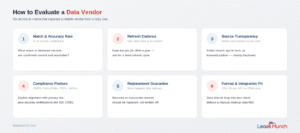
How to Evaluate a Data Vendor?
Before committing budget, a technical evaluation should look past the sales pitch and into a handful of measurable factors.
Match and accuracy rateWhat percentage of delivered records are verified as live and correctly matched? Vendors confident in their process will quote this number directly.
Refresh cadenceGiven that B2B contact data decays roughly 20–30% annually, ask how often the underlying dataset gets re-verified: monthly, quarterly, or not at all.
Source transparencyA vendor should be able to explain, in specific terms, where a given record originated: public record, opt-in form, or licensed partner.
Compliance postureLook for explicit alignment with GDPR, CAN-SPAM, CCPA, and, if health or sensitive data is involved, HIPAA, along with any security certifications like ISO 27001.
Replacement or accuracy guaranteeA vendor willing to replace hard-bounced or inaccurate records after delivery has more skin in the game than one selling data as-is with no recourse.
Format and integration fitConfirm the data arrives in a format your CRM or outreach tool can actually ingest, CSV, Excel, or a direct API/CRM sync, without a manual cleanup step first.
A Real-World Comparison
The cut-rate scraped list
A growth team buys a cheap, unverified list scraped from public web pages with no refresh schedule attached. Within weeks, bounce rates climb past 15%, sender reputation takes a hit, and the “savings” evaporate into wasted sending infrastructure and a damaged domain.
The verified, refreshed alternative
A comparable team instead works with a vendor that refreshes data on a fixed cycle, discloses its sourcing, and backs delivery with a replacement guarantee. Bounce rates stay low, deliverability holds, and the dataset keeps working months after purchase instead of decaying on delivery.
LeadsMunch as a Data Vendor
LeadsMunch is a working example of what a full-stack data vendor looks like in practice. Operating since 2015, it maintains a dataset spanning 6 billion+ records across 180+ countries, covering business and consumer email lists, verified phone numbers, and job-role-segmented contact data across hundreds of industries.
What separates a data vendor built for longevity from one selling a static file is the process behind delivery. LeadsMunch runs records through raw collection, cleaning and enrichment, and multi-level verification before anything ships, and refreshes its datasets on a 90-day cycle to keep pace with natural data decay. Every order is backed by a bounce-back guarantee: if delivered accuracy falls short, affected records get replaced at no extra cost. On the compliance side, LeadsMunch aligns with GDPR, CAN-SPAM, CCPA, HIPAA, and holds ISO/IEC 27001 and 27701 certifications, which matters if your outreach touches regulated regions or sensitive data categories.
Beyond ready-made lists, LeadsMunch operates as a broader data solutions provider; custom list building, data appending, data verification, data mining, and enrichment services sit under one roof, so a vendor relationship can expand as your data needs get more specific. You can request a free sample before committing, or explore the full LeadsMunch data ecosystem to see how the pieces fit together for your specific use case.
Bottom line:
Not all data vendors are built the same. The difference between a dataset that compounds in value and one that decays on arrival comes down to sourcing transparency, refresh cadence, verification rigor, and compliance posture, not just price per record. Evaluate vendors on those terms, and a data partnership becomes an asset instead of a recurring cleanup job.

1 Comment