No products in the cart.
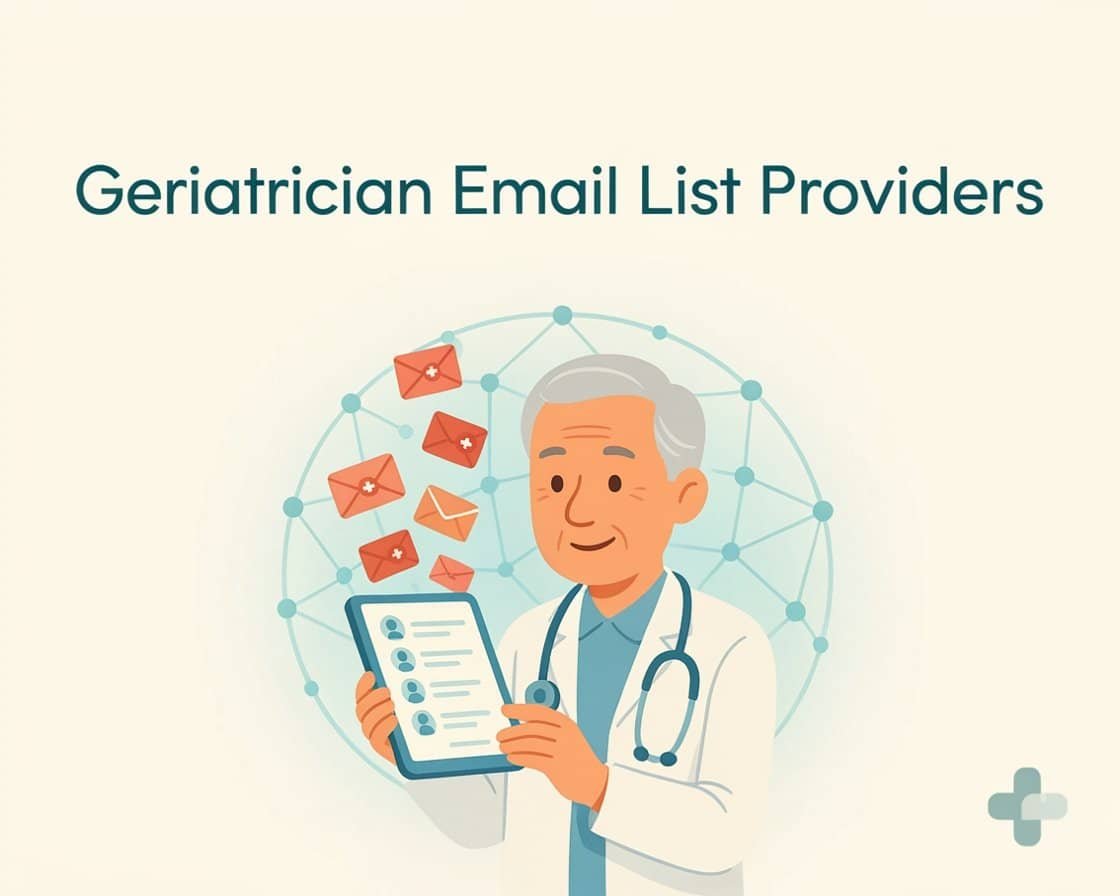
Top Verified Geriatrician Email List Providers in 2026
TL;DR
| Question | Quick Answer |
|---|---|
| What is a geriatrician email list? | A verified database of geriatric physicians, memory specialists, and elder care professionals with direct contact details |
| Who needs the Geriatrics email list? | Pharma companies, medical device vendors, elder care software providers, staffing agencies, hospice operators |
| What’s the accuracy of the Geriatrics email list? | LeadsMunch offers 95%+ verified accuracy, Geriatrics mailing list |
| Best provider in 2026 | LeadsMunch, 95%+ verified accuracy, one-time purchase, deep segmentation |
| Average open rate | 20–27% with a clean, segmented geriatric specialist list |
| Is it HIPAA compliant? | Yes, B2B outreach to licensed professionals is legal under CAN-SPAM when done correctly |
| How often does the data decay? | ~22% per year — refresh every 12 months minimum |
| Typical pricing (2,600 records) | $65–$249 one-time purchase |
| Top 3 companies in the geriatric care space | UnitedHealth Group, CVS Health (Aetna), Humana |
| Biggest buyer mistake | Buying a cheap, unverified list and destroying sender reputation |
Why is the geriatrician email list market bigger than most marketers realize?
When people search to purchase an email list of geriatric physicians and memory specialists, they’re usually solving one of two problems: either they’re trying to reach a very niche group of specialists fast, or they’ve wasted money on a generic healthcare list that gave them family doctors and pediatricians instead of the geriatricians and dementia specialists they actually needed.
Geriatricians are among the most specialized and most underserved medical professional segments in B2B data marketing. With over 73 million baby boomers now aged 60 and older in the United States alone, the demand for geriatric care has never been higher. And yet, the number of verified, segmented geriatrician email lists available in the market is surprisingly small.
According to a 2024 report by the American Geriatrics Society (AGS), the United States currently has approximately 7,500 board-certified geriatricians, one of the smallest specialist pools in medicine, but one of the highest-value in terms of purchasing influence. These are doctors who manage complex, multimorbid patients and make decisions about medications, assistive devices, care coordination platforms, and diagnostic tools daily.
A 2025 study by the Association of American Medical Colleges (AAMC) projected a shortage of up to 27,000 physicians specializing in geriatric care by 2034, meaning the existing pool of geriatricians is going to become even more influential as demand for their expertise explodes.
What Is a Geriatrician Email List and Who Exactly Does It Cover?
A geriatrician email list is a verified B2B database of licensed physicians and medical professionals who specialize in the care of elderly patients, typically those aged 65 and older with complex, chronic, or age-related conditions.
Who is typically included in a quality geriatrician mailing list:
- Board-certified geriatricians (MD or DO with geriatric medicine subspecialty)
- Geriatric psychiatrists (specialists in mental health conditions of aging patients)
- Memory clinic specialists and dementia care physicians
- Palliative care physicians working with elderly populations
- Long-term care medical directors at nursing homes and assisted living facilities
- Hospitalist geriatricians at acute care hospitals
- Academic geriatric physicians at teaching hospitals and medical schools
- Geriatric nurse practitioners and physician assistants in elder care settings
What each record should include:
- Full name and direct email address
- Specialty and subspecialty
- NPI number
- Practice name and type (private, hospital-based, academic)
- Office address (city, state, zip)
- Direct phone number
- Hospital or health system affiliation
- Years in practice
Who buys these geriatrician mailing lists:
- Pharmaceutical companies with geriatric-focused drug portfolios (Alzheimer’s, osteoporosis, hypertension)
- Medical device manufacturers (mobility aids, diagnostic equipment, remote monitoring)
- Elder care software vendors (care coordination platforms, EHR systems for SNFs)
- Staffing agencies placing geriatric physicians and APPs
- Hospice and home health agencies seeking referral partnerships
- Continuing medical education (CME) providers
- Diagnostic companies targeting high-volume geriatric testing
How many geriatricians are there in the United States right now?
Current geriatric workforce data (2025):
- ~7,500 board-certified geriatricians practicing in the US (American Geriatrics Society, 2024)
- ~1,200 geriatric psychiatrists with subspecialty certification
- ~3,400 geriatric nurse practitioners and physician assistants
- ~15,000 physicians with a self-identified geriatric focus but not formally subspecialty-certified
- ~16,000 nursing home and long-term care medical directors (many with a geriatric focus)
States with the highest concentration of geriatricians:
- California, New York, Texas, Florida, Pennsylvania — the same states that have the largest elderly populations
The total addressable geriatric specialist market in the US is approximately 25,000–35,000 professionals when you include all adjacent elder care physician roles. That’s a concentrated, high-value audience, far more manageable than a general physician list of 800,000+ contacts, and far more relevant for your specific product or service.
What are the Top 3 healthcare companies dominating the geriatric care space?
Understanding the market leaders helps you frame your positioning when reaching geriatricians, especially if your product integrates with their existing systems or complements the care models these companies have built.
1. UnitedHealth Group (UHG)
- Founded: 1977 by Richard Burke
- Headquarters: Minnetonka, Minnesota
- Revenue: $371.6 billion (2023), largest health insurance company in the world by revenue
- USPs: UHG operates Optum, one of the largest healthcare services and analytics divisions globally. In geriatric care, Optum manages care for millions of Medicare Advantage members — a population that is predominantly elderly. UHG’s scale, data analytics capabilities, and physician practice acquisitions (including geriatric-focused primary care practices) make it the dominant force in organized elder care delivery. Their Medicare Advantage plans cover more elderly Americans than any other insurer.
2. CVS Health / Aetna
- Founded: CVS founded in 1963 (Lowell, Massachusetts); Aetna founded in 1853 (Hartford, Connecticut); merged in 2018
- Headquarters: Woonsocket, Rhode Island
- Revenue: $357.8 billion (2023)
- USPs: Through the CVS-Aetna merger and its acquisition of Oak Street Health (a primary care network focused on Medicare patients), CVS Health has become a major operator in geriatric primary care. Oak Street Health runs 169+ centers specifically targeting Medicare-eligible patients, making CVS Health a direct provider of geriatric care services at scale. Their MinuteClinic network and pharmacy infrastructure also support medication management for elderly patients, a critical component of geriatric care.
3. Humana
- Founded: 1961 by David Jones Sr. and Wendell Cherry
- Headquarters: Louisville, Kentucky
- Revenue: $106.4 billion (2023)
- USPs: Humana is arguably the most geriatric-focused of the major insurers. Their Medicare Advantage plans cover more than 5.7 million members, the majority of whom are elderly. Humana has invested heavily in home health (through its acquisition of CenterWell Home Health), senior primary care centers (CenterWell Senior Primary Care), and geriatric-focused pharmacy services. Their explicit strategic focus on “senior-centered care” makes them unique among major health companies.
Understanding these companies matters when you’re marketing to geriatricians; many of your target contacts work within these systems, are part of affiliated networks, or make prescribing and purchasing decisions within the care models these giants have established.
Why is a verified geriatrician email list so hard to find from generic providers?
This is the question that brings most serious buyers to specialty providers like LeadsMunch in the first place.
The core problem with general healthcare email lists:
Most large B2B data providers (ZoomInfo, Dun & Bradstreet, generic healthcare list brokers) build their physician databases around the broadest, most common specialties: family medicine, internal medicine, cardiology, orthopedics, and oncology. These are the high-volume specialties with thousands of practitioners.
Geriatrics, by contrast, has only ~7,500 board-certified practitioners in the entire US. That’s a thin slice of a 900,000+ physician universe. Generic providers often:
- Lump geriatricians in with “internal medicine” (where geriatrics is a subspecialty)
- Include unverified or outdated records because the specialty is small enough to fall below their verification threshold
- Can’t properly filter by geriatric subspecialty vs. general gerontology vs. long-term care medicine
- Miss memory clinic physicians, geriatric psychiatrists, and PACE program directors entirely
The result is that when you buy a geriatrician email list from a generalist data provider, you often get a hodgepodge of general internists with aging patients, not true geriatric subspecialists.
This is precisely why specialty healthcare data providers matter for this particular audience. The geriatrics email list from LeadsMunch is specifically built around geriatric subspecialty classifications, NPI-verified specialty codes, and cross-referenced hospital and nursing home affiliation data, giving you the precision that generalist databases simply can’t provide.
For a broader view of how to evaluate any healthcare email list before buying, the healthcare email lists buying guide covers the full framework.
What makes a geriatrician email list high-quality in 2026?
Not all geriatrician lists are built equally. Here’s exactly what separates a premium list from a waste of budget:
Quality signals to look for:
- Subspecialty filtering — Can they distinguish between a geriatrician at a memory clinic vs. a long-term care medical director vs. a palliative care physician? Precision matters.
- Practice settings included: hospital—based, private practice, academic, nursing home, hospice. Your message should differ significantly depending on the setting.
- 90-day or shorter re-verification cycle — Geriatricians switch institutions, retire, or change practice focus more frequently than many specialties. Stale data is expensive.
- Bounce guarantee — A confident provider backs their data with a replacement policy for hard bounces above the threshold.
- Affiliation data — Does the record include hospital or health system affiliation? This is critical for understanding the geriatrician’s purchasing environment.
Red flags that mean the list is likely garbage:
- “Verified,” but no timestamp on when verification occurred
- Unable to filter by practice setting
- No sample records available
- Pricing that seems impossibly cheap (under $50 for thousands of records)
- No bounce replacement policy
For a deeper look at how to evaluate any provider’s verification claims, the guide on verified email database providers walks through a step-by-step testing framework.
Top Geriatrics Email List Providers in 2026

1. LeadsMunch – Best Overall for Verified Geriatric Specialist Data
LeadsMunch has built one of the most credible specialty physician email databases in the healthcare B2B data market. Their geriatrics email list is specifically constructed around geriatric subspecialty codes, not generic internal medicine catchalls.
Why LeadsMunch is the best for healthcare email lists
- 95%+ verified accuracy — achieved through NPI cross-referencing, institutional affiliation verification, and rolling 90-day re-verification cycles
- Subspecialty depth — separates geriatricians from geriatric psychiatrists, memory clinic physicians, long-term care directors, and palliative care specialists
- One-time purchase model — no subscription lock-in, no monthly fees, no automatic renewals
- Practice setting segmentation — filter by hospital-based, private practice, academic, SNF/nursing home, or PACE program
- State-level filtering — target geriatricians in specific states or metro areas
- NPI numbers included — every record is verifiable against the public CMS NPI registry
- Bounce guarantee — replacements provided for records that hard-bounce above the threshold
The broader healthcare professionals email list from LeadsMunch is also worth noting for campaigns that want to extend reach beyond geriatricians into adjacent elder care roles.
LeadsMunch Rating:
9.8/10
2. DataAxle – Best for Enterprise Healthcare Campaigns
DataAxle has a large healthcare database and a strong enterprise support infrastructure. For very large campaigns needing CRM integration and dedicated account management, they’re a solid choice.
Strengths:
Large database, Salesforce/HubSpot integration, dedicated account management
Weaknesses:
Geriatric subspecialty precision is limited; the subscription model is expensive; no transparent pricing
DataAxle Rating:
7.8/10
3. Exact Data – Best for Small, Targeted Geriatric Campaigns
Exact Data’s pay-per-record model works well for buyers who need a small, highly targeted list (under 2,000 records) for a focused campaign.
Strengths:
Pay-per-record flexibility, sample records available, decent support
Weaknesses:
Smaller database, lower accuracy claims (88%), limited subspecialty filtering for geriatrics specifically
Exact Data Rating:
7.1/10
4. InfoUSA – Best for Legacy Enterprise Multichannel Campaigns
InfoUSA has been in the B2B data space for decades and has large databases, but its geriatric subspecialty precision has not kept pace with specialty-focused providers.
Strengths:
Large database, multichannel data (email + direct mail + phone), enterprise SLAs
Weaknesses:
Geriatric subspecialty filtering is weak, subscription-only, and the accuracy in niche medical specialties is lower than claimed
InfoUSA Rating:
6.6/10
What types of products and services should use a geriatrician email list?
This list of use cases is more specific than most guides give you — and specificity is exactly what geriatric B2B marketers need.
Pharmaceutical and drug companies:
- Alzheimer’s disease and dementia medications (acetylcholinesterase inhibitors, NMDA antagonists, new amyloid-targeting biologics)
- Osteoporosis treatment drugs
- Polypharmacy management tools and deprescribing resources
- Pain management products appropriate for elderly patients
Medical devices and diagnostics:
- Cognitive assessment tools and digital screening platforms
- Fall prevention and remote monitoring devices
- Mobility and assistive technology
- Diagnostic imaging for age-related conditions
Software and technology:
- EHR systems specialized for nursing homes and SNFs (PointClickCare, MatrixCare competitors)
- Care coordination and care management platforms
- Telehealth solutions for homebound elderly patients
- Medication management and reconciliation software
Staffing and workforce solutions:
- Geriatric physician placement agencies
- Locum tenens for nursing home medical directors
- Geriatric care management staffing
Education and CME:
- Board certification preparation courses
- Geriatric medicine CME conferences and webinars
- Dementia care training programs
For all of these use cases, the starting point is a geriatrics email list that actually gives you true subspecialist contacts, not generic internists approximating geriatric care.
Campaigns targeting adjacent elder care facilities (nursing homes, hospices, home health agencies) should also consider the nursing homes email list, hospices email list, and homecare agencies email list from LeadsMunch — giving you full coverage of the geriatric care ecosystem.
How do you write an email that a geriatrician will actually open and read?
Getting the leads list right is step one. Writing the email that performs with this specific audience is step two. Geriatricians are:
- Among the busiest physicians in medicine (managing 20–40+ patients per day with complex needs)
- Highly skeptical of generic pharmaceutical and device marketing
- Motivated by evidence, patient outcomes, and practical clinical utility — not price or features
What works with geriatricians:
Subject lines:
- “New evidence on fall prevention in patients over 80”
- “3 things top-performing memory clinics do differently”
- “Dr. [Last Name] — quick question about your polypharmacy protocol”
- “Reducing Beers Criteria risks in your panel — a tool worth looking at”
Email body principles:
- Lead with a clinical insight, not a product pitch
- Reference the specific patient population they serve (frail elderly, dementia patients, PACE enrollees)
- Use one credible clinical reference or outcomes stat
- Keep under 150 words for the first email
- Single CTA: a 15-minute clinical conversation, a resource download, or a demo request
What to avoid:
- Generic “healthcare professional” language
- Mentioning features before outcomes
- Long paragraphs listing product specs
- Aggressive pricing language
A clean geriatrician email list combined with clinically-informed messaging is one of the highest-ROI outreach strategies available in healthcare B2B marketing, precisely because so few vendors execute both parts well simultaneously.
For broader campaign strategy across physician specialties, the B2B email marketing guide covers sequencing, deliverability, and conversion benchmarks in depth.
What are the benchmarks for a successful geriatrician email campaign?
Know what “good” looks like before you launch, so you can diagnose performance accurately.
Benchmark data for healthcare specialist email campaigns (Mailchimp 2025, Validity Inc. 2025):
- Open rate: 20–27% for verified, segmented specialist lists
- Click-through rate: 2.5–5% for relevant clinical offers
- Reply rate (cold outreach sequences): 0.5–2% is realistic and strong
- Hard bounce rate: Under 2% for freshly verified lists; above 5% signals a data quality crisis
- Unsubscribe rate: Under 0.4% for well-targeted campaigns
Campaign ROI benchmarks:
A pharmaceutical company reaching 5,000 geriatricians with a targeted CME-linked email sequence might see:
- 1,150 opens (23% open rate)
- 200 clicks (4% CTR)
- 50 demo/conversation requests (25% of clickers converting to the next step)
- 12 new prescriber relationships formed
- Average lifetime value per geriatric prescriber: $15,000–$80,000 depending on drug category
That’s significant ROI from a list that costs under $1,000.
If your open rate falls below 15% or your bounce rate exceeds 2%, the problem is data quality, not your messaging. Start by testing your list against the verified email database providers framework before scaling your campaign.
For understanding how data decay affects your list performance over time, what is data decay is a must-read before your second campaign.
Is it legal and compliant to purchase and use a geriatrician email list?
Yes, and this is one of the most common questions from first-time healthcare B2B marketers. Let’s be precise about what applies here.
HIPAA: HIPAA’s privacy regulations protect patient health information (PHI). A geriatrician’s professional contact information — their name, NPI number, practice address, email, and specialty- is not PHI. It is professional directory information, publicly sourced from the CMS NPI registry and state licensing boards. HIPAA does not prohibit marketing to licensed physicians using their professional contact information.
CAN-SPAM Act:
What governs commercial email sent to physicians is CAN-SPAM. Requirements:
- Include your physical business address in every email
- Provide a clear, functional unsubscribe mechanism
- Honor unsubscribe requests within 10 business days
- Use honest, non-deceptive subject lines
- Identify the message as a commercial communication
What to avoid:
Never mix patient data with physician contact data. Never purchase lists that include patient information. If you’re operating across international markets, CASL (Canada) and GDPR (EU) apply to physician contacts in those jurisdictions; both have stricter requirements than CAN-SPAM.
For a comprehensive overview of healthcare email compliance, the healthcare email list providers resource covers data sourcing compliance in depth.
Why LeadsMunch is the go-to choice for healthcare marketers targeting geriatricians
Let’s be direct about why LeadsMunch keeps coming out on top specifically for geriatric specialist campaigns.
1. They built for specialty depth, not breadth.
LeadsMunch isn’t trying to be the world’s biggest data company. They specialize in verified healthcare professional data, which means their geriatric specialist lists are built with the precision that a generalist data broker simply can’t offer for a niche with only ~7,500 board-certified practitioners.
2. No subscription lock-in.
The majority of pharmaceutical and medical device marketing teams running 1–2 geriatric campaigns per year don’t need, and shouldn’t pay for, a $2,000/month subscription. LeadsMunch’s one-time purchase model is built for exactly this use case.
3. Adjacent specialty lists for full ecosystem coverage.
Beyond the core geriatrics email list, LeadsMunch covers the full elder care specialist ecosystem: neurologists for dementia-focused campaigns, psychiatrists for geriatric mental health outreach, physical therapists for rehabilitation product campaigns, pain management specialists for chronic pain products targeting elderly patients, nursing homes, hospices, and homecare agencies.
4. Transparent sourcing and testable accuracy.
LeadsMunch sources from the CMS NPI registry, state licensing boards, hospital affiliation directories, and professional associations. Their accuracy claims are testable: request a sample, cross-reference with the NPI registry, and run through ZeroBounce. The data holds up.
5. Responsive support with healthcare market knowledge.
LeadsMunch’s support team understands the nuances of specialty physician marketing — not just data fulfillment. When you need to ask whether a specific subset of geriatric specialists is covered, they can answer with confidence.
For marketers who are still deciding between buying a list and building leads organically, buying email lists vs. lead generation is worth reading before you commit to either approach.
FAQs About the Geriatrician Email List
What is a geriatrician email list?
- A geriatrician email list is a verified B2B database of licensed physicians specializing in geriatric medicine, the care of elderly patients, typically aged 65 and older, with complex, chronic, or age-related conditions. Each record includes the physician’s name, email address, NPI number, specialty, practice setting, and location. Marketers use these lists to reach geriatricians with relevant pharmaceutical, device, software, or staffing outreach without going through institutional gatekeepers.
How many geriatricians are there in the United States?
- As of 2024, the American Geriatrics Society reports approximately 7,500 board-certified geriatricians in the US. When you include geriatric psychiatrists, geriatric nurse practitioners, and physicians with a primary focus in geriatrics, the total addressable specialist population is approximately 25,000–35,000 professionals. This makes geriatricians one of the smallest but highest-value physician specialty segments available in B2B healthcare data.
How much does a geriatrician email list cost?
- A high-quality geriatrician email list with 2,000–5,000 verified records typically costs $65–$249 for a one-time purchase. National lists with broader coverage run $500–$900. Subscription-based enterprise providers charge $1,000–$5,000+ per month for access to healthcare specialists. LeadsMunch offers one-time purchase pricing with no subscription lock-in, making it the most cost-effective option for most geriatric marketing campaigns that run annually rather than continuously.
Is it legal to buy and email a geriatrician list?
- Yes. Geriatricians’ professional contact information sourced from the CMS NPI registry, state licensing boards, and professional directories is not protected health information under HIPAA. Emailing a geriatrician about a pharmaceutical product, medical device, or clinical software is B2B commercial communication — governed by CAN-SPAM, which requires an unsubscribe option, your business address, and honest subject lines. Always consult your legal team for jurisdiction-specific compliance questions.
How do I verify that a geriatrician email list is accurate?
- Request 10–20 sample records and take three steps: run the emails through ZeroBounce or NeverBounce; cross-reference NPI numbers against the free public CMS NPI registry at nppes.cms.hhs.gov; and verify practice affiliations against the health system’s physician directory. If more than 1–2 of 10 records fail verification, the list quality is poor. LeadsMunch’s geriatrics email list passes all three checks because it’s NPI-sourced and rolled 90-day verified.
What’s a good open rate for geriatrician email campaigns?
- Based on 2025 benchmarks from Mailchimp and Validity Inc., a verified, segmented geriatric specialist email campaign should achieve 20–27% open rates. Click-through rates of 2.5–5% indicate strong offer relevance. For cold outreach sequences, reply rates of 0.5–2% are excellent and realistic. If your open rate is below 15% or your bounce rate exceeds 2%, you have either a data quality problem or a deliverability problem, and both need immediate attention.
What should I sell to geriatricians via email?
- The highest-performing offers for geriatrician email campaigns include: Alzheimer’s and dementia drug updates and CME content; fall prevention and remote monitoring devices; polypharmacy management tools and deprescribing resources; care coordination software; telehealth platforms for homebound patients; geriatric staffing solutions; and diagnostic tools for age-related conditions. The key is to lead with clinical relevance and patient outcomes, not product features, in every email sent to this evidence-oriented specialty.
How is a geriatrician email list different from a general physician list?
- A general physician list includes all specialties, family medicine, cardiology, orthopedics, pediatrics, and hundreds more, of which geriatricians represent under 1%. Sending a geriatric drug or device offer to a general list wastes 99%+ of your budget on irrelevant contacts. A specialty-specific geriatrics email list contains only verified geriatric subspecialists, memory clinic physicians, and elder care medical directors, giving you 95%+ relevance on every send.
Can I target geriatricians by practice setting?
- Yes, and you should. A geriatrician at a hospital-based academic medical center has different purchasing authority than a nursing home medical director or a private memory clinic physician. Premium list providers like LeadsMunch segment by hospital-based, private practice, academic, skilled nursing facility (SNF), PACE program, and hospice settings. Matching your offer to the practice setting significantly improves open rates, reply rates, and downstream conversion.
How often should I refresh my geriatrician email list?
- Physician contact data decays at approximately 20–25% per year. In a specialty as small as geriatrics, where physicians frequently transition between nursing home directorships, academic roles, and private practice, decay can be even higher. Refreshing your geriatrician list annually is the minimum standard. Providers like LeadsMunch re-verify on rolling 90-day cycles, which means their lists are significantly more current than those of competitors with annual refresh cycles at the time of purchase.
What email sequence works best for reaching geriatricians cold?
- For cold outreach to geriatricians, a 4-email sequence over 2–3 weeks performs best: Email 1, introduce yourself with a patient-centered clinical hook; Email 2 (3 days later), clinical evidence or outcomes data relevant to their patient population; Email 3 (5 days later), a peer case study or testimonial from a similar geriatric practice; Email 4 (7 days later), a polite breakup email leaving the door open. Total sequence length should be under 4 weeks, with no more than 1 email every 2–3 days.
What’s the ROI of a geriatrician email list campaign?
- ROI varies significantly by product category. A pharmaceutical company reaching 5,000 geriatricians with a relevant drug update campaign at a 23% open rate and 4% CTR generates 200 engaged physician contacts. Converting 6% of those to prescriber relationships at $25,000 average lifetime value generates $300,000 in revenue from a list that cost under $800. That’s a 375x return on list investment — achievable with clean data, a relevant offer, and a clinically informed email sequence. The geriatrics email list from LeadsMunch provides the data quality foundation for that calculation to hold.
Does a geriatrician email list include memory specialists and dementia physicians?
- A quality geriatrician list should include memory clinic physicians and dementia specialists, but you need to confirm this with your provider before purchasing. Generic lists often label these contacts as neurologists or psychiatrists rather than geriatricians. LeadsMunch’s geriatric specialist database is cross-referenced against subspecialty NPI taxonomy codes, ensuring that memory clinic physicians, behavioral neurologists specializing in dementia, and geriatric psychiatrists are all properly categorized and included when relevant to your campaign.
Can I combine a geriatrician list with other healthcare specialty lists for a broader campaign?
- Yes, and for most healthcare B2B campaigns, a multi-specialty approach significantly expands your addressable market. For geriatric-focused campaigns, LeadsMunch lets you combine the geriatrics email list with complementary lists for neurologists, primary care physicians, physical therapists, pain management specialists, and nursing homes, creating a full ecosystem campaign covering the entire geriatric care continuum.
What tools should I use to send emails to a geriatrician list once I buy it?
- For cold B2B outreach sequences to geriatricians, platforms like Instantly.ai, Smartlead, Lemlist, or Apollo.io are built for cold email automation with domain warmup and sequence management. For newsletter or announcement-style sends to opted-in physician contacts, ActiveCampaign, Mailchimp, or HubSpot work well. Always warm up your sending domain before deploying to any new list, start at 50–100 sends per day and scale gradually over 2–4 weeks to protect your sender reputation and maintain deliverability.
Final Thoughts: What Should You Do Next?
The geriatric specialist market is both smaller and more valuable than most B2B healthcare marketers expect. With only ~7,500 board-certified geriatricians in the US, a clean, verified list gives you complete market penetration — not just a sample.
The single most important decision you’ll make is choosing a provider who actually understands geriatric subspecialty classifications, not one who approximates it with internal medicine catchalls.
Start here:
- LeadsMunch geriatrics email list — primary geriatrician contacts
- Nursing homes email list — long-term care facility contacts
- Neurologists email list — memory and cognitive specialist outreach
- Hospices email list — end-of-life care facility contacts
- Homecare agencies email list — home health referral partners
- Healthcare professionals email list — broad elder care ecosystem coverage