No products in the cart.

What is Deliverability in Email Marketing?
You’ve probably heard the word deliverability if you’ve spent any time working on email marketing. Maybe a colleague mentioned it, or you saw it in a guide about improving your campaigns. But what does it actually mean, and why does it matter so much?
In plain words, email deliverability is about whether your email actually lands in someone’s inbox, not their spam folder, not their promotions tab, but the real inbox where they’ll actually notice it. An email can technically get “delivered” to a person’s email server without ever landing anywhere they’ll see it. If it gets caught by a spam filter or buried in another tab, it doesn’t matter how good your email copy looks; nobody’s going to read it.
So here’s a simple way to think about it: what good is an email if nobody ever sees it? That’s the whole idea behind deliverability. It’s not just about writing a great email; it’s about making sure that great email actually gets in front of the person you wrote it for.
Why Email Deliverability Matters?
Picture this: you spend hours writing the perfect email. A great subject line, solid copy, and a sharp offer. You automate your campaign, feeling good about it. Then you check your numbers, open rates are low; clicks are even lower. What happened?
Chances are, a chunk of your emails never actually reached the inbox. They got filtered into spam or blocked altogether. When deliverability is poor, it drags down your whole email marketing effort in a few clear ways:
Lower engagement
If an email doesn’t reach the inbox, nobody can open it or see it, read it, or click on it. All the effort that went into writing it goes to waste, and your message never gets the chance to do its job.
Damaged sender reputation
Big email providers like Gmail, Yahoo, and Outlook are always watching how your emails perform. If too many of them get marked as spam or simply ignored, your reputation with these providers drops, and that makes future emails even harder to deliver.
Wasted money and effort
If your emails aren’t reaching people, your campaigns aren’t doing their job. All the time, effort, and budget spent creating them isn’t bringing back the results it should.
Lost trust
If your emails keep landing in spam folders, people start to see your brand as something they never asked for. That quietly damages the relationship you’re trying to build with them.
What Affects Email Deliverability?
Your sender reputation, technical authentication, and recipient engagement determine email deliverability. Internet service providers (ISPs) like Gmail and Yahoo filter emails based on how you authenticate your domain, how often users mark your emails as spam, and your list hygiene.
Key factors that directly impact your inbox placement include:
- Authentication Protocols: Missing domain authentication signals to ISPs that you might be a spoofer. Proper setup of SPF, DKIM, and DMARC acts as your digital driver’s license.
- Sender Reputation: ISPs track your sending history. Consistently hitting spam traps, having high bounce rates, or being placed on blocklists will severely damage your reputation.
- Recipient Engagement: Positive signals (opens, clicks, replies) boost deliverability, while negative actions (deleting without reading, spam complaints) send your emails to the junk folder.
- List Hygiene: Sending to unverified or stale email addresses creates high bounce rates and damages your domain authority.
- Sending Volume & Consistency: Spiking your sending volume suddenly (e.g., sending to 100,000 users one day after only sending 50 the previous day) triggers spam filters.
How Deliverability Rates Actually Look
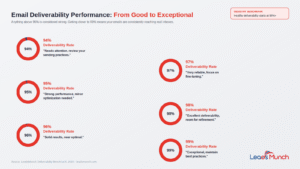
To see how this plays out in real numbers, take a look at the chart below. Anything above 95% is generally considered strong, and the closer you get to 99%, the more consistently your emails are landing in real inboxes instead of getting lost along the way.
How to Improve Your Email Deliverability
Once you know what affects deliverability, improving it comes down to a few consistent habits.
1. Clean your list regularly
Remove subscribers who never open your emails, and make sure every address on your list is valid and actually opted in.
2. Warm up your IP address
If you’re sending from a brand-new IP address, ramp up your volume slowly instead of sending thousands of emails all at once. This helps you build trust with email providers over time.
3. Use a reliable email service provider
Pick a provider known for strong deliverability practices, with built-in tools to help you track and improve your sending.
4. Watch your numbers
Keep an eye on your bounce rate, open rate, and spam complaints. If any of these start slipping, dig into why before it turns into a bigger problem.
5. Test before you hit send
Use an email testing tool to check how your message looks and whether it’s likely to get flagged as spam before it ever reaches your full list.
Deliverability vs. Delivery Rate: What’s the Difference?
Delivery Rate is simply the percentage of your sent emails that reach the recipient’s mail server without bouncing. It only proves the email was accepted. Deliverability, on the other hand, measures whether your email actually reached the primary inbox rather than being diverted to the spam folder or blocked entirely.