No products in the cart.
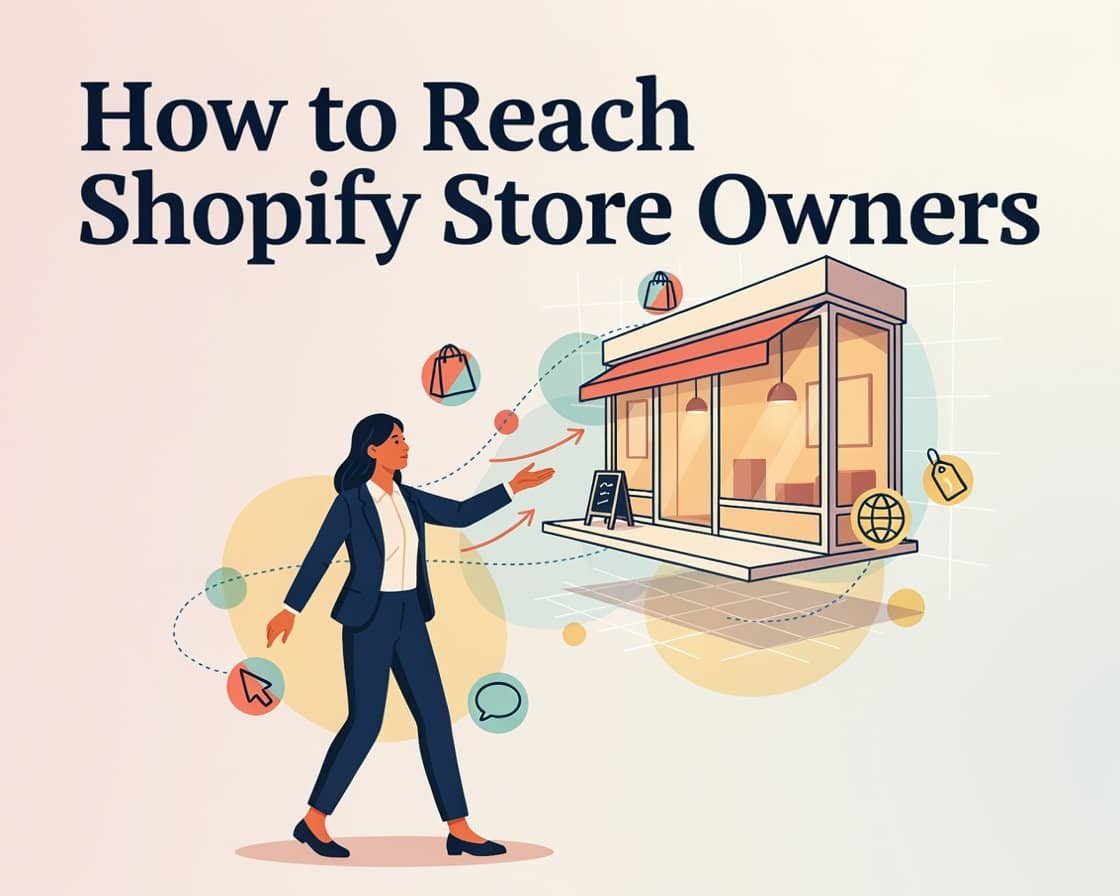
How to Reach Shopify Store Owners: 7 Proven Ways for 2026
TL;DR, Quick Answer Table
| Method | Best For | Typical 2026 Reply/Response Rate | Time to First Results |
|---|---|---|---|
| Verified Shopify email lists | Fast, scalable cold outreach | 3.4%–10.7%+ with clean data | 1–2 weeks |
| Cold email outreach | SaaS, apps, agencies pitching stores | 3.43% average, 8–12% for personalized sends | 2–4 weeks |
| LinkedIn outreach | High-ticket B2B, agency partnerships | 1–3% connection-to-reply | 3–6 weeks |
| Shopify App Store presence | App and plugin developers | Ongoing, compounding | 2–6 months |
| Paid social/search ads | Brand awareness, retargeting | Varies by CPC/CPM | Days |
| Content/SEO for merchants | Long-term inbound pipeline | Compounding over 6–12 months | 3–12 months |
| Agency & influencer partnerships | Warm introductions at scale | High trust, lower volume | 1–3 months |
How Do You Reach Shopify Store Owners in 2026?
The fastest, most repeatable way to reach Shopify store owners in 2026 is a combination of verified contact data and a compliant, well-sequenced outreach channel, usually cold email, LinkedIn, or both. Shopify now powers somewhere between 2.85 million and 6.9 million live storefronts worldwide, depending on how “active” is measured, with roughly 70,000+ of those running on the enterprise-grade Shopify Plus tier. That scale is exactly why so many SaaS founders, agencies, and B2B sellers struggle to get a reply: they’re guessing at who owns which store, sending from unwarmed domains, or emailing addresses that were never verified in the first place.
The 7 methods below are ranked by how buyers actually search for them, starting with the fastest and most scalable (verified email lists and cold email) and moving through LinkedIn, app-store visibility, paid ads, content, and partnerships.
Top Methods to Reach Shopify Store Owners in 2026
1. Where Can I Buy a Verified List of Shopify Store Owners?
Buying a pre-verified list is the single fastest way to start conversations with Shopify merchants, because it removes the weeks normally spent scraping, guessing, and manually building a custom shopify stores list. A good Shopify store owners email list should already be segmented by store size, category, and geography, and it should come with a bounce guarantee rather than a “best effort” disclaimer.
What to check before buying:
- Verification recency — was the list checked in the last 30–90 days, or is it a static export from last year?
- Segmentation depth — can you filter by USA Shopify stores, UK Shopify stores, or store revenue band?
- Compliance documentation — does the provider publish how the data was sourced and how it stays aligned with US and international email marketing law?
- Bounce protection — is there a replacement or bounce-back guarantee if the delivery rate falls short?
This is where LeadsMunch’s Shopify datasets (covered in detail further down) fit directly into the workflow, but the checklist above applies regardless of which verified email database provider you ultimately choose.
2. How Do I Write a Cold Email That Shopify Store Owners Actually Reply To?
Shopify merchants are busy operators, not enterprise procurement teams, so the winning cold email format looks nothing like a corporate pitch deck. Recent 2026 benchmarking shows the average cold email reply rate sits around 3.43%, but sequences that reference a specific, verifiable signal- a recent product launch, a seasonal sale, a new app installed, climb toward 15–25% reply rates. The gap isn’t better writing; it’s better targeting on a clean, opt-in-respecting list.
Practical structure that works for Shopify owners:
- Subject line under 6 words, referencing their store name or category, not your product
- First line proves you looked at their store — not a generic “Hi {{firstName}}.”
- One clear ask, not three — book a call, try a free audit, or reply “interested”
- 50–125 words total, since Shopify owners read email on their phones between orders
- A 4–7 email follow-up sequence, since roughly 42–44% of positive replies come from follow-ups, not the first send
- Proper SPF, DKIM, and DMARC setup so the message lands in the inbox instead of spam
For formatting mechanics — greeting, sign-off, spacing, a quick refresher on how to format a cold email and better alternatives to “I look forward to hearing from you” can lift reply rates without touching your offer at all.
3. What Is a Good Open and Reply Rate When Emailing Shopify Merchants?
A good cold email open rate in 2026 is generally cited as 45% or higher, with the overall average closer to 44%, though Apple Mail Privacy Protection has made open-rate tracking structurally unreliable since it preloads pixels for a large share of Apple Mail users. Reply rate is the more trustworthy metric to optimize for.
Benchmarks worth anchoring to:
- Average reply rate: roughly 3.1%–3.7% across large 2026 datasets
- Top 25% of senders: 5.5%+
- Top 10% of senders (elite): 8%–12%, occasionally 15%+ with signal-based targeting
- E-commerce/retail-specific outreach: averages around 3.9% reply rate, per industry vertical benchmarking
- Bounce rate ceiling: stay under 3%, ideally under 1.5%
- Spam complaint ceiling: stay under 0.3%, ideally under 0.1% to satisfy Google and Yahoo’s bulk sender rules
Verified lists reportedly produce nearly double the reply rate of unverified lists, which is the core argument for starting with email list providers built specifically for cold emailing rather than scraping addresses manually.
4. How Do I Find Shopify Store Owners on LinkedIn?
LinkedIn works best as a trust-building layer alongside email, not a replacement for it — most Shopify founders and DTC operators keep their profiles updated even when their store inbox is neglected. Search combinations like “Shopify,” “founder,” “DTC,” or “ecommerce” narrowed by industry and headcount (1–10 or 11–50 employees) surface most independent store owners; Shopify Plus merchants are easier to filter by company size and revenue signals.
Tactics that convert:
- Comment genuinely on their product posts before connecting
- Reference a specific product line in the connection note, not a generic pitch
- Follow up the connection with a short, non-salesy message; save the offer for message two or three
- Cross-reference LinkedIn profiles against your Shopify Plus users email list so email and LinkedIn touches land in the same week
A LinkedIn lead generation service can handle this at scale if manual prospecting isn’t realistic for your team’s bandwidth.
5. How Do I Get My App or Service in Front of Shopify Store Owners Through the App Store?
If you sell a Shopify app, theme, or plugin, App Store visibility compounds in a way outbound never will, but it’s slow, and most new apps sit on page three or four for months before ranking. Pairing App Store optimization with direct outreach shortens that runway considerably.
What moves the needle:
- Keyword-optimized app title and description matching how merchants actually search (“email popup,” “abandoned cart,” not internal product names)
- Review velocity — actively (and honestly) asking early users for reviews rather than waiting passively
- A free tier or trial that lets a merchant test value before installing a paid plan
- Direct outreach to newly launched or recently switched stores, since merchants who just migrated to Shopify are actively evaluating new apps
- Case studies from real stores, ideally segmented by store category or revenue band
Combining App Store discovery with a targeted email push to newly active stores from a custom list building service consistently outperforms waiting for organic App Store traffic alone.
6. Are Paid Ads Worth It to Reach Shopify Store Owners?
Paid ads on Meta, Google, and LinkedIn can work for reaching Shopify store owners, but they’re better suited to retargeting a warm audience than cold prospecting, since ad platforms have limited native targeting for “runs a Shopify store” as a standalone filter. Most B2B sellers pair a small paid budget with outbound rather than relying on ads alone.
Where paid spend performs best:
- Retargeting website visitors who came from an outbound email or LinkedIn touch
- Lookalike audiences built from a list of known Shopify store owner email addresses (with proper consent and platform-compliant list uploads)
- Google Search ads on high-intent terms like “Shopify email marketing agency” or “Shopify app for [problem].”
- Sponsored content in Shopify-specific newsletters and communities, which often converts better than generic social ads
Because Shopify store-owner targeting on ad platforms is imprecise, most teams treat email list providers for cold emailing as the primary channel and ads as a supporting layer, not the reverse.
7. How Do Agencies and Partnerships Help Reach Shopify Store Owners Faster?
Partnering with Shopify-focused agencies, freelancers, and app developers gives access to warm introductions that outbound alone can’t replicate, because these partners already have the merchant’s trust. This is the slowest method to set up but often produces the highest-quality conversations once it’s running.
How to build this channel:
- Identify agencies serving your target store size (small independent stores vs. Shopify Plus enterprise accounts)
- Offer a genuine referral incentive, not just a link exchange
- Co-host a webinar or write a joint guide solving a real merchant problem
- Layer this with B2B data enrichment, so you know exactly which stores a partner’s client list touches before you reach out
Partnerships rarely scale on their own, which is why most growth teams run them in parallel with a verified Shopify and Amazon seller database rather than treating referrals as the sole pipeline source.
Why List Quality Determines Whether Any of This Works
Every method above depends on one thing: whether the email address or LinkedIn profile you’re targeting is current and correctly matched to a real, active Shopify store. A few concepts worth understanding before you spend a marketing budget:
- Data decay — B2B contact data degrades continuously as people change roles, stores close, or domains lapse, which is why a list bought two years ago underperforms one verified this quarter.
- Data enrichment and data appending — adding missing fields (revenue band, tech stack, phone number) to an existing list without re-scraping from scratch.
- Email list segmentation — splitting a broad Shopify list by geography, store category, or Plus vs. standard tier so messaging stays relevant.
- Hard bounces and suppression lists — the mechanics that protect your sending domain’s reputation when addresses go bad.
- Deliverability — the umbrella metric that determines whether any of the above channels can even reach an inbox in the first place.
Understanding these fundamentals, and knowing the difference between buying a list versus running full-service lead generation, is what separates campaigns that scale from ones that get flagged as spam after week one.
Featured Provider: LeadsMunch, Verified Email Lists for Shopify Store Owners
LeadsMunch has been a B2B contact data and list-building provider since 2015, built for teams that need to reach specific, hard-to-segment audiences quickly, and Shopify store owners are one of its most requested datasets. Rather than selling one generic global export, LeadsMunch structures its Shopify store owners email list by geography and store tier, so a SaaS company selling to small independent merchants isn’t paying for the same dataset as an agency chasing Shopify Plus enterprise accounts.
Every record goes through a verification pass before delivery, and the company backs its data with a bounce-back guarantee rather than asking buyers to accept degraded lists on faith. LeadsMunch also offers custom list building, data appending, and data scraping services for teams whose targeting criteria fall outside a standard segment. The company’s approach mirrors how it explains its own process on the how we work page: source, verify, segment, and deliver, with compliance built into each step rather than bolted on afterward. For teams running outbound campaigns into the Shopify ecosystem specifically, this segment-first structure removes a step most generic data vendors leave entirely to the buyer.
Best For:
LeadsMunch Shopify store owners email list is best for SaaS companies, marketing agencies, app developers, and B2B sellers who need verified, geography- and tier-segmented contact data for Shopify store owners, especially teams targeting USA, UK, or Shopify Plus merchants specifically.
Key Features
- Store-tier segmentation (standard Shopify vs. Shopify Plus)
- Geography filters, including dedicated USA and UK Shopify datasets
- Pre-delivery email verification to reduce hard bounces
- Bounce-back guarantee on delivered records
- Combined Shopify and Amazon seller data for cross-platform sellers
- Compliance-aware sourcing referencing applicable email marketing regulations
Key Services
- Pre-built Shopify store owner email lists
- Custom list building for niche or multi-criteria targeting
- Data appending and enrichment for existing CRM records
- Data scraping services for public-record-based prospecting
- Cold email management for teams that want outreach handled end-to-end
- Data analytics and warehousing support for larger campaign operations
Pricing:
LeadsMunch offers tiered subscription plans based on list quantity and segmentation depth, with custom quotes available for enterprise or multi-market Shopify Plus targeting. Exact pricing depends on volume, geography, and whether verification or enrichment add-ons are included, so requesting a quote through the pricing page is the most accurate way to budget a campaign.
How Much Does a Shopify Store Owners Email List Typically Cost?
Pricing for B2B contact lists generally scales with three variables: list size, segmentation depth, and verification recency. A broad, unsegmented export costs less per record than a tightly filtered list of, say, only Shopify Plus stores generating $1M+ in annual GMV, because narrower segments require more sourcing and verification work per contact. Buyers comparing options should look at affordable email list providers alongside premium, fully-managed options, and weigh cost-per-verified-contact rather than cost-per-thousand-raw-records, since a cheap list full of dead addresses is more expensive in wasted sending reputation than a smaller, cleaner one.
Is Buying a Shopify Store Owners Email List Legal?
Buying and emailing a B2B contact list is legal in the United States under CAN-SPAM and in most jurisdictions when done correctly, but the rules differ by region and by whether contacts are treated as B2B or B2C. In the US, CAN-SPAM requires accurate sender information, a working unsubscribe mechanism, and no deceptive subject lines; it does not require prior opt-in for B2B email the way GDPR does for EU consumers. UK and EU-based outreach carries stricter consent expectations, which is one reason a dedicated UK Shopify store owners list built with regional compliance in mind matters more than a single undifferentiated global export. This is general information, not legal advice; teams running outreach into multiple jurisdictions should confirm current requirements with legal counsel before scaling volume.
How Accurate Are Shopify Plus Merchant Email Lists Compared to Standard Store Lists?
Shopify Plus merchant data tends to be more accurate on average than data for small independent stores, mainly because Plus merchants have public-facing teams, listed executives, and stable domains, making verification easier. Independent single-owner stores are more volatile; many launch and close within the first year, which accelerates data decay faster than enterprise segments. This is exactly why segmenting a purchase toward the Shopify Plus users email list specifically, rather than buying an all-tier blended dataset, generally produces a lower bounce rate for teams targeting larger merchants.
Should I Target USA, UK, or Global Shopify Store Owners First?
The right starting geography depends on where your product or service already has proof points, not just where the most Shopify stores exist. The United States holds the largest share of active Shopify stores globally, commonly cited between roughly 37% and 39% of the total, making a USA Shopify store owners email list the highest-volume starting point for most English-language outreach. The UK is consistently the second-largest Shopify market, which makes a UK-specific list worth testing separately rather than blending it into a US campaign, since messaging, currency references, and even send-time windows differ. Sellers also targeting cross-platform merchants should look at the combined Shopify and Amazon stores database, since a meaningful share of Shopify merchants also run parallel Amazon storefronts.
How Do I Combine a Shopify Email List With Cold Email Software?
Most cold email tools accept a CSV upload, so the practical steps are: verify the list one more time at import (even a pre-verified list benefits from a fresh check before a large send), split it into daily send batches to protect domain reputation, and build a 4–7 email sequence rather than a single blast. Segment sends by the fields your Shopify store owners email list already includes, store category, tier, or geography, so each batch gets a tailored first line instead of one generic template. Run a basic A/B test on subject lines across the first 10–15% of the list before committing the full send, and route non-responders into a lead nurturing sequence instead of writing them off after one no-reply.
What’s the Difference Between Buying a List and Using a Lead Generation Agency?
Buying a list gives you the raw contact data and puts the outreach execution in your hands; a full-service lead generation agency handles sourcing, sequencing, and follow-up on your behalf, typically at a higher monthly cost. Teams with an in-house SDR or founder-led sales motion usually get more value from a verified email list they can control directly, while teams without outreach bandwidth often prefer a cold email management service that runs the full campaign. A detailed breakdown of when each model makes sense is covered in buying email lists vs. lead generation.
What Mistakes Cause Outreach to Shopify Store Owners to Fail?
Most failed campaigns don’t fail because of weak copy; they fail because of avoidable structural mistakes made before the first email goes out. Recognizing these early saves both budget and sending reputation.
- Sending to an unsegmented, all-tier list. Blending small independent stores with Shopify Plus accounts forces generic messaging that under-performs for both groups.
- Skipping domain warm-up. New domains sending high volume on day one see inbox placement fall as low as 12%, compared to 87%+ for a properly warmed setup — the blacklisting guide covers the exact ramp-up schedule.
- Treating a list as a one-time purchase. Because of ongoing data decay, a list that performed well six months ago may already carry a meaningfully higher bounce rate today.
- Ignoring suppression and unsubscribe hygiene. Re-emailing people who already opted out, or never cleaning a suppression list, drives spam complaints above the 0.3% ceiling that triggers Google and Yahoo’s bulk-sender penalties.
- Only sending one email. Since a substantial share of positive replies come from the second through fifth touch, stopping after one email leaves measurable pipeline on the table.
- No geographic tailoring. Sending identical copy to USA and UK merchants ignores differences in currency, spelling, and even reasonable send-time windows across time zones.
Fixing these six issues before scaling volume — rather than after a domain gets flagged- is consistently the difference between a channel that compounds and one that gets abandoned after a single disappointing send.
FAQs about how to reach Shopify store owners
What is the best way to reach Shopify store owners in 2026?
Combining a verified email list with a personalized, multi-touch sequence yields the highest reply rates. While cold email acts as the primary driver, multi-channel outreach that incorporates secondary trust-building channels like LinkedIn significantly lifts response metrics. Successful campaigns isolate key operational pain points, segment store owners by revenue bracket, and deliver concise value propositions tailored specifically to e-commerce decision-makers rather than relying on generic, unsegmented messaging.
How many active Shopify stores are there right now?
Estimates place the active Shopify store count between 2.85 million and 6.9 million live sites. The variance stems directly from tracking methodologies: lower estimates measure actively trading storefronts with consistent transactional volume, while higher figures capture all detectable live sites, including temporary, paused, or developmental domains. Targeting active outbound campaigns against strictly verified, operational domains ensures budget efficiency and protects domain health from abandoned store pages.
How many Shopify Plus stores exist?
There are between 45,000 and 76,000 active Shopify Plus stores globally, with the United States accounting for roughly 40% to 55% of the total enterprise market. These enterprise-level merchants feature larger operational footprints, higher transaction volumes, and dedicated department leads. Outreach strategies targeting this segment must focus on enterprise integration, multi-channel scale, and advanced logistics rather than basic store utility or low-tier app subscriptions.
Can I email Shopify store owners without prior consent?
In the US, B2B cold email is legal under CAN-SPAM without prior consent, provided sender information is accurate and a clear opt-out mechanism is included. Conversely, international jurisdictions like the UK and EU enforce stricter rules under GDPR and PECR, requiring explicit consent or strict legitimate interest proof. Compliance requires auditing recipient locations, updating suppression lists instantly, and adhering to regional privacy regulations before deploying global cold email sequences.
What is a realistic reply rate when cold emailing Shopify merchants?
Average e-commerce outreach reply rates typically range between 3.1% and 3.9%. Highly optimized campaigns using verified data, sharp segmentation, and personalized messaging consistently achieve reply rates of 8% to 12% or higher. Overall response rates fluctuate based on deliverability health, offer relevance, decision-maker targeting, and avoiding saturated, generic templates. Tracking replies serves as a key indicator of messaging strength and list hygiene over raw open metrics.
Is it better to buy a list or scrape Shopify store data internally?
Scraping data internally provides direct control over data fields, but demands ongoing engineering bandwidth, proxy infrastructure, and continuous email verification tools to manage data decay. Purchasing lists from reputable data vendors shifts the maintenance burden off internal teams, delivering pre-verified records instantly. The decision hinges on available technical resources, internal budget, and whether your outbound engine requires steady real-time lead generation or periodic bulk sequence loading.
How often should a Shopify store owners list be re-verified?
Shopify data decays rapidly as stores close, change tech stacks, or rotate key staff members. Lists should undergo automated re-verification every 60 to 90 days to eliminate invalid email addresses and preserve domain health. Rapidly shifting categories, such as newly launched storefronts, require monthly verification sweeps. Cleaning lists before deploying new sequences prevents hard bounce spikes that trigger inbox provider spam filters and domain blocklists.
What is the difference between a USA and a global Shopify store list?
A USA-specific list provides a single regulatory framework under CAN-SPAM, standardized currency messaging, and unified timezone scheduling. A global Shopify list opens a larger total addressable market but requires granular segmentation. Targeting international merchants demands localized currency references, region-specific shipping considerations, and strict compliance alignment with varying privacy laws such as GDPR in Europe or CASL in Canada across separate outbound campaigns.
Do Shopify Plus merchants respond differently to cold outreach than small store owners?
Yes. Shopify Plus merchants operate with specialized heads of marketing, operations, and logistics who ignore generic small-business pitches. Enterprise leads respond best to outreach addressing high-volume operational complexities, such as enterprise ERP integrations, custom checkout workflows, multi-warehouse fulfillment, and omnichannel inventory sync. Effective messaging targets specific role-based pain points rather than broad, single-owner store management topics commonly sent to smaller merchants.
How do I avoid getting my domain blacklisted when emailing a large Shopify list?
Preventing domain blacklisting requires proper DNS authentication setup, including SPF, DKIM, and DMARC records, alongside gradual domain warming over 4 to 6 weeks. Senders must cap daily email volume per mailbox, spread sends across multiple domains, and verify email lists to keep bounce rates under 2%. Including clear opt-out links and monitoring Google Postmaster Tools ensures sender reputation remains healthy during high-volume outbound campaigns.
Can I combine a Shopify email list with a Shopify and Amazon seller list?
Combining Shopify and Amazon merchant databases is an effective strategy for pitching multi-channel tools, fulfillment solutions, or cross-platform inventory management software. Many established e-commerce brands maintain storefronts on both platforms simultaneously. Segmenting merchants who operate across both channels allows campaign managers to tailor outreach around channel synchronization, unified inventory tracking, and multi-platform advertising management to boost pitch relevance and response rates.
What email open rate should I expect when targeting Shopify merchants?
Average email open rates for e-commerce B2B outreach hover around 44% to 45%. However, machine opens driven by privacy features like Apple Mail Privacy Protection artificially inflate open rate statistics across the industry. Outbound teams should view open metrics as a secondary health indicator and focus primarily on reply rates, booked meetings, and inbox placement reliability to accurately measure campaign performance against benchmark goals.
How is a Shopify store list different from a general e-commerce list?
A Shopify-specific list is filtered strictly to confirmed active storefronts running on the Shopify platform, rather than generic e-commerce platforms like WooCommerce, Magento, or BigCommerce. Targeting a dedicated Shopify audience allows software developers, agencies, and service providers to pitch platform-specific integrations, native apps, and specialized workflows that only apply to the Shopify ecosystem, eliminating wasted outreach budget on incompatible technology stacks.
What deliverability infrastructure is needed before sending to a purchased Shopify list?
Proper deliverability infrastructure requires dedicated sending domains separate from your primary corporate domain, fully configured SPF, DKIM, and DMARC records, and automated inbox warmup tools. Senders must deploy email verification software to scrub hard bounces, establish an active suppression list process, and rotate sending across multiple inbox accounts to maintain low per-mailbox daily volumes and prevent spam placement.
What is the most effective secondary channel for reaching Shopify store owners?
LinkedIn serves as the premier secondary channel alongside cold email. Most Shopify founders, e-commerce directors, and marketing leads maintain active professional profiles on the platform. Executing soft LinkedIn touches, such as connection requests, profile views, or direct messages during the same week as email touches creates multi-channel touchpoints. This synchronized approach reinforces brand trust, increases open rates, and drives higher overall campaign conversions than single-channel outreach.
Final Takeaway
Reaching Shopify store owners in 2026 comes down to two compounding factors: how current and well-segmented your contact data is, and how disciplined your sending infrastructure is. Cold email, LinkedIn, App Store visibility, paid ads, content, and partnerships each play a role, but none of them work at scale on stale, unverified data. Starting with a verified, geography- and tier-segmented Shopify store owners email list, whether USA, UK, Shopify Plus, or combined Shopify and Amazon sellers — removes the single biggest point of failure before the first email is even sent. From there, the FAQs above and the pricing page are the two fastest next steps toward a live campaign.